“The Key to Armenia Is the Armenian Language”
Avetik Isahakyan
A shared love and devotion to the Armenian language once again brought together those for whom the mother tongue is not merely a subject to be taught, but a sacred mission: preserving our national identity and passing it on to future generations.
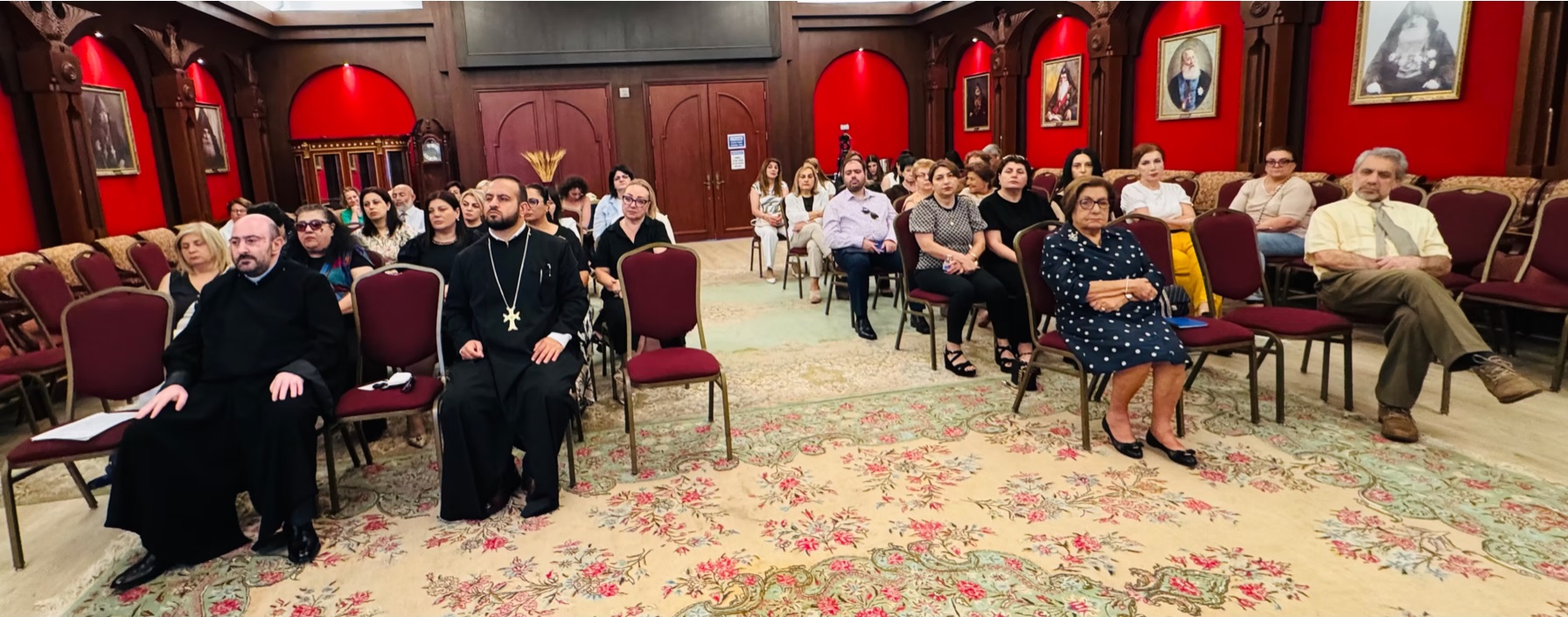
On August 8, 2026, the Western Diocese hosted the annual workshop of Armenian language educators, under the presidency of the Diocesan Primate Archbishop Hovnan Derderian.
For many years, this initiative has served as an important forum for the professional development of teachers from the Western Diocese’s Saturday schools, the exchange of experience, and discussion of innovative approaches to education. In recent years, however, its geographic reach has expanded, taking on a truly pan-Armenian character and bringing together educators from different countries who are dedicated to preserving and promoting the Armenian language.
The gathering opened with remarks by one of its principal organizers, Deacon Hovhannes Gumruyan, spiritual overseer of the Western Diocese’s Saturday Schools and Principal of the “Little Angels” Saturday School. He expressed his gratitude to all the participants and underscored the importance of the gathering, noting that “the purpose of this event is not limited to the discussion of academic subjects. It is a valuable forum for professional dialogue, the exchange of pedagogical experience, and the exploration of contemporary approaches to education, where every participant has the opportunity to refresh their knowledge, discover new methods, and enrich their own teaching experience.”
Fr. Hovhannes emphasized the teacher’s vital responsibility, noting that educators teach children not only to preserve their mother tongue, but also to live through it—to think, create, and discover the world in Armenian.
The participants then received the paternal blessing and message of His Eminence Archbishop Hovnan Derderian, the longtime Primate of the Western Diocese. The Archbishop distilled the message of the day into a single word: service. Quoting from the letters of St. Paul the Apostle on the subject of service, he emphasized that those who willingly take upon themselves the yoke of service are worthy of honor. He directed this message to the assembled teachers, who dedicate their minds, hearts, souls, and patience to God’s sacred work of educating and nurturing Armenian children. The Primate expressed his deep appreciation for their devoted work, emphasizing that educators have undertaken a service that is both responsible and honorable.
Dr. Ellie Andreasyan, Chair of the Educational and Academic Committee, also offered words of welcome. She spoke about the importance of teaching the mother tongue in the Diaspora, describing it as a fundamental condition for preserving cultural heritage and strengthening national identity.
One of the principal speakers was Hasmik Hovhannisyan, a longtime Armenian language and literature teacher and educational methodologist. She provided a comprehensive presentation on the primary goals of teaching the mother tongue in the Diaspora: preserving national identity and Armenian linguistic thought, developing a living and practical command of the language, and strengthening the connection between the mother tongue, literature, and history.
Hovhannisyan placed particular emphasis on the teacher’s role in developing a child’s independent thinking. In her view, a good teacher does not simply impart knowledge, but cultivates in students the ability to think critically and form their own judgments.
The speaker also discussed the work “The Key to Armenia” from Vardges Petrosyan’s Armenian Sketches, presenting its content and central theme. The story’s protagonist is a young boy who speaks Armenian with an English accent and asks his father to bring him the key to Armenia. Hovhannisyan connected this episode to the challenge of preserving the mother tongue and national identity in the Diaspora, emphasizing that language is one of the inseparable foundations of a people’s existence. She also recalled the well-known thought of K. D. Ushinsky, who described language as a fundamental pillar of a people’s existence and identity. She concluded her presentation with the words of Avetik Isahakyan: “The key to Armenia is the Armenian language.”
The next speaker was Dr. Ashot Galstyan, Doctor of Philological Sciences, Professor, and Dean of the Faculty of Philology at the Armenian State Pedagogical University named after Khachatur Abovyan in Yerevan.
In his presentation, Professor Galstyan emphasized that the existence of a nation cannot be measured solely by state borders. It continues wherever language, historical memory, and spiritual values are lived and passed from one generation to the next. In this context, he quoted the well-known words of Paruyr Sevak: “To remember the past does not mean moving into the past, but bringing the past into the present.”
According to Galstyan, wherever Armenians live, they carry within themselves the voice of Armenia today, continuing the enduring journey of Armenian identity through national culture, the mother tongue, and the Church. One of the central themes of his presentation was the need for new approaches to teaching Armenian in Diaspora one-day schools. He highlighted the use of contemporary interactive methods, the incorporation of QR codes into educational curricula, the purposeful adaptation of lengthy texts, and the effective use of digital tools.
He also addressed the opportunities offered by artificial intelligence, noting that new digital tools can be used to create engaging educational programs, exercises, and learning materials, making them more accessible and appealing to today’s students.
The speaker observed that the educational environment is changing rapidly, and methods that were effective in the past do not always have the same impact on today’s students. Therefore, educators themselves must continually grow, embrace innovation, and be able to make Armenian language lessons lively, engaging, and relevant to children’s everyday lives.
Notably, this year’s Pan-Armenian gathering brought together approximately 120 educators. About 60 attended in person at the Diocese’s Hampar Hall, while the others participated online from Armenia, Russia, various European countries, India, and different cities across the United States. The broad geographic representation of participants once again demonstrated the gathering’s truly pan-Armenian scope.
The final speaker of the day was Mariam Azolyan, an education specialist, parents’ advocate, and director of financial literacy programs.
She spoke about the educational needs of children requiring additional support and the importance of individualized approaches, placing particular emphasis on effective communication and the development of mutual trust between teachers and students. Azolyan stressed that every child is unique and, therefore, effective education entails not only imparting knowledge but also understanding each learner’s needs, abilities, and individual characteristics.
The gathering concluded with the Lord’s Prayer. At the close of the day, participants received recently published works from the Diocese from the Primate and departed with his spiritual blessing and renewed enthusiasm, prepared to continue their responsible and sacred service in the new academic year.
Very Rev. Fr. Hovhannes Gumruyan congratulated the participants on the beginning of the new academic year, wishing them a peaceful, fruitful, and creative year filled with new achievements in education, a thirst for learning among their students, and renewed expressions of love for the Armenian language.
The annual gathering of Armenian language teachers once again affirmed that preserving and teaching Armenian in the Diaspora is far more than an educational endeavor. It is an essential means of safeguarding national memory, transmitting cultural heritage, and ensuring the continuity of Armenian identity.
Today, as Armenian children grow up in multilingual and multicultural environments, the teacher’s mission carries an even greater responsibility. The mother tongue connects the new generation to its history, culture, faith, and homeland, while the teacher, through knowledge and dedication, strengthens that vital bond.
The key to Armenia is the Armenian language. And among those entrusted with passing that key from one generation to the next are the devoted teachers of the Armenian language.
Anahit Amiryan
Teacher, “Little Angels” Saturday School